
 Login
LoginITIL® 4 vs ITIL® (Version 5)
ITIL (Version 5) vs ITIL 4: Key Differences, Updates, and Certification Paths
Summary of Topics
ITIL (Version 5) is the latest global standard for managing digital products and services, designed to help IT, product, and business professionals excel in service management. Announced in January 2026, the new ITIL version introduces updated practices, modules, and processes that modernize IT service management.
Below, you’ll find a detailed comparison with previous ITIL versions, highlighting the key updates, changes, and enhancements.
ITIL 4 vs ITIL (Version 5): Key Differences, Updates, and What’s Changed
ITIL (Version 5) helps organizations manage digital products, services, customer experiences, and end-to-end digital operations in a structured, future-ready framework.
- AI-Native & Digital-First: Built for AI-driven, fast-paced organizations, with governance designed to be AI-ready from the start.
- End-to-End Product and Service Lifecycle: Extends traditional ITIL to fully support Digital Product & Service Management.
- Customer-Centric Focus: Ensures transparency, measurable value, and enhanced experiences across all stakeholders.
- Practical, Flexible Guidance: Provides actionable, adaptable recommendations for real-world adoption—less abstract, more dynamic.
- Role-Aligned Clarity: Offers targeted guidance tailored to specific roles and responsibilities for faster implementation.
- Backward Compatible: Safeguards existing ITIL investments while supporting modern updates and practices.
One Unified Product & Service Lifecycle
Many organizations treat products and services separately, which can create gaps in delivery speed, reliability and customer experience. But in reality:
- Products are what organizations build
- Services are how value is delivered and supported
Digital products and services are two sides of the same solution.
ITIL (Version 5) unifies them into a single lifecycle, enabling teams to:
- Design together
- Build and launch together
- Operate and improve together
With a unified lifecycle, organizations achieve faster delivery, fewer gaps, better customer experiences, and stronger business outcomes.
What’s Unchanged from ITIL 4 to ITIL (Version 5)
- ITIL Guiding Principles – Core principles continue to guide decision-making and best practices across all IT service activities.
- Four Dimensions of Service Management – The holistic approach covering organizations, people, information, technology, partners, and processes remains intact.
- ITIL Service Value System (SVS) – The SVS framework still ensures value co-creation through all IT service management activities.
- ITIL Practices (34) – All 34 practices remain, with only minor updates to terminology to reflect modern approaches.
- ITIL Foundation as the Entry Point – The ITIL Foundation continues to serve as the starting point for all certifications and learning paths.
- Global Trust, Scale, and Recognition – ITIL’s worldwide credibility and adoption remain unchanged, maintaining its value for organizations and professionals.
Changes in the ITIL (Version 5) Certification Scheme
The ITIL (Version 5) designations remained the same as the previous ITIL 4 certification scheme:
- ITIL Practice Manager (Version 5)
- ITIL Managing Professional (Version 5)
- ITIL Strategic Leader (Version 5)
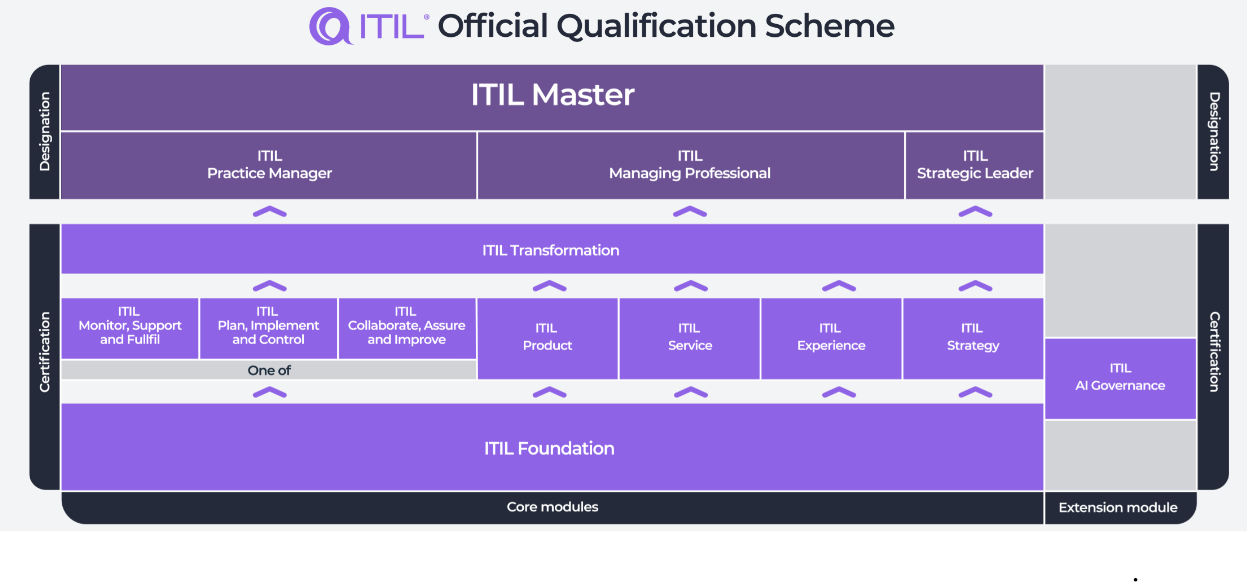
However, the process to achieve each designation, as well as the certifications required for each qualification, has been simplified in ITIL (Version 5).
Below are the key updates in the new ITIL certification scheme:
- ITIL Foundation remains the entry-level certification and is mandatory for all advanced designations.
- Practitioner modules no longer exist as standalone certifications; they are now included in each ITIL Practice Manager certification (ITIL PIC, ITIL CAI, ITIL MSF).
- Each ITIL certification stream now has its own simplified and reduced set of modules. There are no longer common modules across streams.
- The ITIL Transformation module is the only common module. It must be taken once to achieve the Practice Manager, Managing Professional, and Strategic Leader qualifications.
- ITIL Master (Version 5) remains the highest designation and requires completion of all relevant ITIL certifications within the scheme.
For more detailed information about the new ITIL (Version 5) certification scheme, visit our dedicated page.
Can ITIL 4 Certified Professionals Upgrade to ITIL (Version 5)?
Yes, transitioning from ITIL 4 to ITIL (Version 5) is fully possible.
PeopleCert provides a clear transition path for ITIL 4 certified professionals, tailored to the specific ITIL 4 certificate you currently hold.
For detailed guidance on how to transition from ITIL 4 to ITIL (Version 5), visit our dedicated page
In summary: Who should buy ITIL (Version 5) and why
ITIL (Version 5) is designed for a wide range of professionals—from experienced IT practitioners to business and product leaders—helping them navigate digital and AI-driven environments. Different roles benefit in different ways, whether it’s advancing skills, enabling enterprise transformation, or improving product and service outcomes.
Existing ITIL Professionals (ITIL v3 and ITIL 4)
- Roles: ITSM managers, operations leaders, service managers, architects
- Why they choose ITIL (Version 5): To stay relevant, advance their careers, gain guidance on adoption, and strengthen credibility in digital and AI-driven environments—building on their existing knowledge and experience.
Enterprise Leaders and Transformation Teams
- Roles: CIOs, CDOs, heads of transformation, enterprise architects
- Why they choose ITIL (Version 5): To create AI-ready digital operating models, align strategy with operations, implement governance, achieve measurable outcomes, and leverage existing investments.
Product, Experience, and Digital Teams (New to ITIL)
- Roles: Product managers, CX leaders, digital delivery teams
- Why they choose ITIL (Version 5): To gain clarity across the product and service lifecycle, focus on experience-driven outcomes, improve cross-team collaboration, and ensure products are aligned with services and business goals.